Books

Balancing Green: When to Embrace Sustainability in a Business (and When Not To)

In this book, supply chain business strategy expert Professor Yossi Sheffi offers a pragmatic approach to how companies of all sizes navigate competing stakeholder demands for corporate profits, jobs, growth, and environmental sustainability.
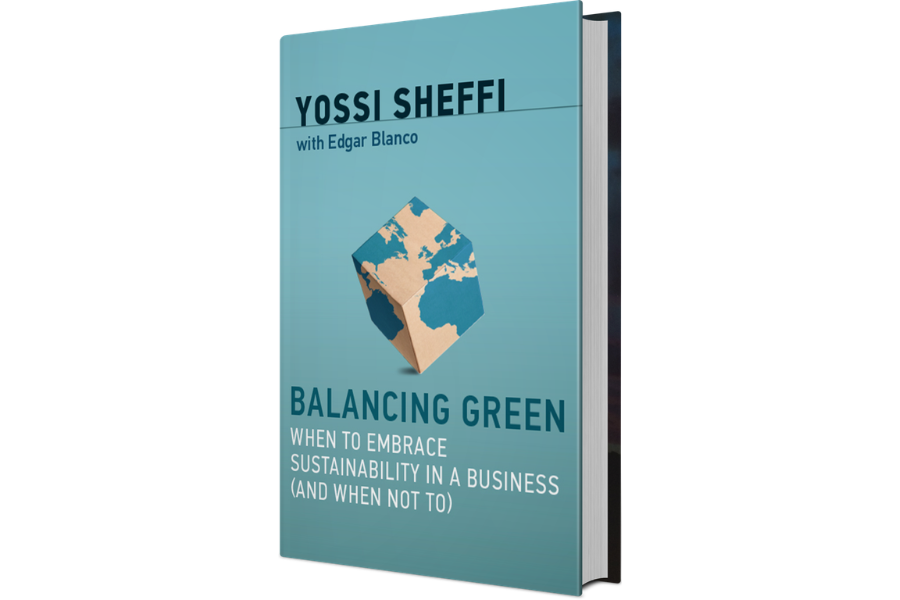
Cover art: Balancing Green

About Balancing Green

The demands and stresses on companies only grow as executives face a multitude of competing business goals. Their stakeholders are interested in corporate profits, jobs, business growth, and environmental sustainability. In this book, business strategy expert Yossi Sheffi offers a pragmatic take on how businesses of all sizes—from Coca Cola and Siemens to Dr. Bronner’s Magical Soaps and Patagonia—navigate these competing goals. Drawing on extensive interviews with more than 250 executives, Sheffi examines the challenges, solutions, and implications of balancing traditional business goals with sustainability. 

Sheffi, author of the widely read The Resilient Enterprise, argues that business executives’ personal opinions on environmental sustainability  are irrelevant. The business merits of environmental sustainability are based on the fact that even the most ardent climate change skeptics in the C-suite face natural resource costs, public relations problems, regulatory burdens, and a green consumer segment. Sheffi presents three basic business rationales for corporate sustainability efforts: cutting costs, reducing risk, and achieving growth. 

For companies, sustainability is not a simple case of “profits versus planet” but is instead a more subtle issue of (some) people versus (other) people—those looking for jobs and inexpensive goods versus others who seek a pristine environment. This book aims to help companies satisfy these conflicting motivations for both economic growth and environmental sustainability.

Professor Sheffi speaks about Balancing Green at CSCMP Conference

MIT Professor Yossi Sheffi discusses his new book, Balancing Green - "When to Embrace Sustainability in a Business - and When Not To." The question at issue: When is sustainability an investment? And when is it a cost? 

Endorsements

“This book offers valuable and expert guidance on how companies can develop business models that successfully meet the needs of different stakeholders.”
—Paul Polman, CEO, Unilever 


“Some in business believe that companies have a responsibility to contribute to society and the environment, while others believe that every investment a company makes must return value. At UPS, we believe that both beliefs are compatible. I applaud Yossi Sheffi for his thoughtful treatment of a subject that is critically important not just to business, but to everyone on this planet.”
—David Abney, Chairman and CEO, UP


"Balancing Green is one of the most compelling business books I have read in the past few years. I admire how you tell the story of 'sustainability' through a series of entertaining and witty accounts written with a very objective view of the reality. It’s a great model for how I would want to write a business book. A fantastic book!"

— Shardul Phadnis, PhD, Director, Center for e-Commerce And Retail Transformation (CART)
Book Reviews

Supply Chain Brain

Q&A | When to Embrace Sustainability — and When Not To

December 14, 2018Robert J. Bowman, SupplyChainBrain

MIT Professor Yossi Sheffi discusses his new book, "When to Embrace Sustainability in a Business — and When Not To." The question at issue: When is sustainability an investment? And when is it a cost?

Q: What was behind the writing of this book?

Sheffi: I started the research about five years ago, assuming that business should lead the way in sustainability, and came to pretty much the opposite conclusion: not only that business cannot do it, it should not do it.

Companies that don't [directly] make anything — think Cisco or Apple or Microsoft — can be very sustainable unless you consider the entire supply chain. We need to look at sustainability as a supply-chain issue. Beyond tier 1, companies don’t really have any visibility. Even if they found out who is the supplier at Tier 3, 4, 5 or 6, they have no leverage with those suppliers.

Read more

Journal of Business Logistics

Abstract

Should business lead on environmental sustainability? The article argues that while there are some environmental initiatives that support the mission of the business, such as energy savings that also reduce costs, business should not go too far. On the one hand, its ability to do so is limited since most of the carbon footprint is outside its four walls, and even where it can make substantial changes, it should not do it until consumers will be willing to pay for it and incur minor inconveniences.

Read more

The Guardian

Profits v planet: can big business and the environment get along?

Sustainability can bring benefits to everybody – including company execs with their eyes on the bottom line

Read more

The Wall Street Journal

Guest Voices: Straw Man Solutions for Sustainable Supply Chains

More companies are banning straws to burnish their environmental credentials. MIT’s Yossi Sheffi writes the impact of such measures is just a drop in the ocean.

The Walt Disney Co. announced late last month it will eliminate single-use plastic straws and plastic stirrers at all owned and operated locations across the globe.

Disney introduced the ban in response to concerns over the amount of waste plastic being dumped in the world’s oceans. The company described the decision as “another important step in our journey of environmental stewardship.”

Read more

UPS Longitudes

Original article appeared in UPS Longitudes in July 2018.  It is no longer available to view. 

The article was republished on Linkedin and can be viewed here.

Communications & Marketing Podcast

The podcast is no longer available. 

‘Balancing Green’ → Yossi Sheffi (Author): When to Embrace Sustainability in a Business (and When Not To) Difficult, awkward, and hard truths about corporate sustainability. 

In the episode, the following topics are discussed: • Balancing green pressures and corporate pressures • It is not planet vs profit, instead it is people vs people • Companies are running the global supply chain, providing the jobs, and are also responsible for a lot of the environmental impact • How many people will pay 10% more money for a sustainable product? • Tesla in Hong Kong: government incentives • Convenience and low-cost vs the environment: How many people buy on Amazon?  How do you feel about the packaging that goes to landfill?  • Until consumers agree to pay more for sustainability, companies will not change their fundamentals of production • Companies will save energy, minimize risk, and hedging with a green product line for millennials • Sustainability is a supply chain issue • Is Apple or Microsoft sustainable?  They do not manufacture anything, until you look at the supply chain impact • Coca-Cola says they reduced the amount of water in bottling plant, but it takes vast amount of water to grow sugar cane • Carbon impact of detergent is making the water hot • Deep sustainability:  Patagonia and Dr.Bronner • Unilever trains farmers who grow tea • Natura invests a lot in the welfare of the Amazon • Starbucks has 120,000 coffee growers who they invest in and train • Is the consumer willing to pay more? • Maybe not until we have a lot more desires • Will Shanghai flood?  • Social responsibility, shared values, and making a case for social responsibility • Supply chain is holistic thinking 

DC Velocity

A pragmatist's take on sustainability: interview with Yossi SheffiIt can be hard to find a nuanced discussion of corporate sustainability. But Yossi Sheffi's new book aims to provide just that, offering a clear-eyed take on the challenges and benefits of going green.

Throughout his career, Massachusetts Institute of Technology (MIT) Professor Yossi Sheffi has researched and written books on a wide variety of supply chain topics, from resiliency to logistics clusters to urban transportation. "I guess I just get bored easily," he quips.

But none of those books gave him as much trouble to write as his most recent one, Balancing Green: When to Embrace Sustainability in a Business (and When Not To).

Read more

Supply Chain Digest

Dr. Yossi Sheffi of MIT is one of the most influential figures in the supply chain, and he is fresh out with another great new book titled Balancing Green: When to Embrace Sustainability in a Business (and When Not To).

As the title suggests, this is a very balanced work that provides a true 360-degree look at this critical topic, impeccably researched, with interviews of some 250 companies as to their sustainability strategies and practices.

Read more: 

SCM world

Sheffi on Sustainability: Green Grows Up, SCM World: A Gartner Community, May 2018.

Forbes

Sheffi on Sustainability: Green Grows Up

By Kevin O'Marah

MIT Professor Yossi Sheffi has just published, along with Edgar Blanco of Amazon, the definitive book on sustainability in business. For supply chain enthusiasts like me the topic is endlessly complex and compelling, but arguably too big to pin down systematically. This new book, Balancing Green, does it. It is deep and technically credible, but also readable and loaded with familiar names and stories. Most importantly, it tackles the question of sustainability without a preconceived agenda.

Read more

Freight Waves

Balancing Green: A Practical Guide to Corporate Sustainability

Yossi Sheffi, Director of the MIT Center for Transportation & Logistics, has recently published a must-read book on sustainability. Balancing Green: When to Embrace Sustainability in a Business (and When Not To) is a well-researched book that cuts through many of the fallacies and wishful thinking that surrounds sustainability. (Forbes)

Read more in Freight Waves

Forbes

Balancing Green: A Practical Guide to Corporate Sustainability

By Steve Banker

Yossi Sheffi, Director of the MIT Center for Transportation & Logistics, has done it again. He recently published a must-read book on sustainability. Balancing Green: When to Embrace Sustainability in a Business (and When Not To) is a well-researched book that cuts through many of the fallacies and wishful thinking that surrounds sustainability.

Read more

Logistics Viewpoints: READ-THINK-SHARE

A Must-Read Business Book on Sustainability

Balancing Green is a must-read business book on sustainability. is a well-researched book that cuts through many of the fallacies and wishful thinking that surrounds this topic.

Yossi Sheffi, Director of the MIT Center for Transportation & Logistics, has done it again. He recently published a must-read business book on sustainability. Balancing Green: When to Embrace Sustainability in a Business (and When Not To) is a well-researched book that cuts through many of the fallacies and wishful thinking that surround the topic of sustainability.

Read more

Phys.org

Expert examines the trade-offs companies face when grappling with sustainability issues

In 2010, the environmental group Greenpeace launched an online campaign against Nestle, the food-production giant. Nestle's KitKat bars, the campaign charged, contained palm oil supplied by a company that was improperly clearing rainforests.

But Nestle, as MIT Professor Yossi Sheffi discusses in a new book on sustainability in business, thought it had already addressed the issue. The company had adopted a "no deforestation" policy, stating it would no longer use palm oil from companies clearing forests after 2005. In 2009, Nestle had joined a group developing industry standards on the issue, the Roundtable on Sustainable Palm Oil.

Read more

MIT News

When going green is not black and white

In a new book, MIT professor Yossi Sheffi examines the trade-offs companies face when grappling with sustainability issues.

Read more

Supply Chain Management Review

Balancing Green: A Q&A with Yossi Sheffi

In his new book, MIT's Sheffi argues that companies need to find the right balance between investments in sustainability and maintaining their competitive advantage.

Read more

Supply Chain Brain (Podcast)

‘Balancing Green’: What’s the Cost of Sustainability?

The debate over green supply chains often breaks down into extreme positions with no prospect for compromise. Some push for sustainability at any cost. Others argue that any green measures are a threat to jobs and corporate profits. It’s clear, though, that a more nuanced approach is necessary if companies are to make any progress on the issue at all. On this episode, we get a look at how nominally clashing viewpoints can move forward with crafting cleaner and greener global supply chains.

Listen here

Get in touch

Professor Yossi Sheffi is available for interviews, Q&As, expert commentary and byline articles, author events, and other public speaking engagements.